
As the pace of digital transformation in the federal government accelerates, limited changes to systems won’t be sufficient. Agencies must also enhance the customer experience.
This is why business analysts today need to do more than just document or translate requirements. At OPTiMO, we believe that effective business analysis drives meaningful customer experience with world-class accessibility while strengthening mission impact.
Our human-centered business analysis methodology combined with focused usability testing allows our teams to deliver solutions that are functional, compliant, intuitive, and trusted by users.
Business Analysis as a Key Driver for Customer Experience
Like Human-Centered Design (HCD), human-centered business analysis is grounded in a core principle: that people must stay at the center of the problem.
This approach is important in the federal space, where the 21st Century Integrated Digital Experience Act (21st Century IDEA) and OMB’s Customer Experience goals set the stage for customer-focused service delivery. These initiatives show a government-wide commitment to providing modern, accessible, and consistent digital experiences.
As government agencies attempt to minimize user pain points and increase trust and access to services, business analysis efforts can help turn policy into practical improvements.
Projects connected to these priorities need more than just functional and technical documentation. They need a clear understanding of user needs, measurable outcomes, and design choices grounded in reality.
At OPTiMO, our analysts are dedicated to this goal. They advocate for users and promote these practices by using methods such as:
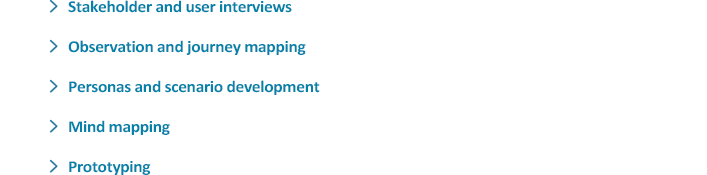
These human-centered business analysis techniques help teams make rational, user-friendly, and compliant decisions.
Embedding Usability Testing into Business Analysis
One powerful way analysts at OPTiMO help boost human-centered business analysis is through focused usability testing.
We incorporate usability testing in every phase of a project to gather direct and actionable feedback from real users. Instead of relying on assumptions, this type of testing allows teams to observe how people interact with a product or service.
Getting users involved early and often helps uncover insights that lead to meaningful improvements in:

Usability testing also strengthens stakeholder alignment by providing evidence to support design choices. It helps teams spot potential issues early, preventing costly problems later in development.
Creating Tests with Purpose
Effective usability testing starts with a clear goal.
Every test our analysts create starts by focusing on a specific question, like:
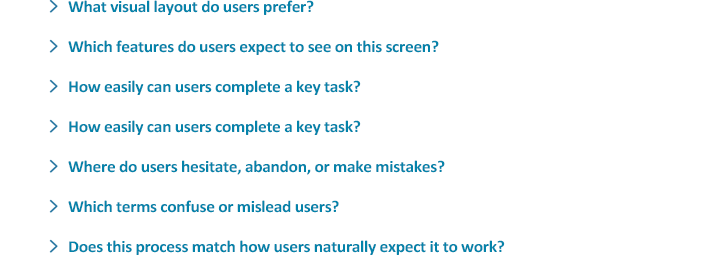
Focusing on a clear testing purpose helps ensure we move beyond personal opinions and gather solid evidence about what works and what doesn’t. It also helps clearly define the type of test needed because different usability tests answer different questions. For example:

With clarity of purpose, we can design the test to gather the right kind of feedback and evidence.
This helps us understand not just if something is usable, but also why certain elements succeed or fail so that we can smartly guide refinements.
From Personas to Participants: Ensuring Relevant Feedback
Even the best usability test won’t yield meaningful results without the right participants.
Feedback is most valuable when it comes from people who represent the intended user group. These users provide the context, expectations, and real-world needs that shape how a solution will be used.
Testing with non-representative participants can lead to misleading conclusions and overlooked risks. Surprisingly, testing with too many people can have unintended consequences as well. Most usability problems are discovered quickly. Research and practice show that after about 5-10 participants, the same issues begin to repeat. Adding more people then uncovers fewer new insights, so the additional effort often produces diminishing returns.
Business analysts are key to making sure usability testing captures perspectives from the right users.
They support this by:
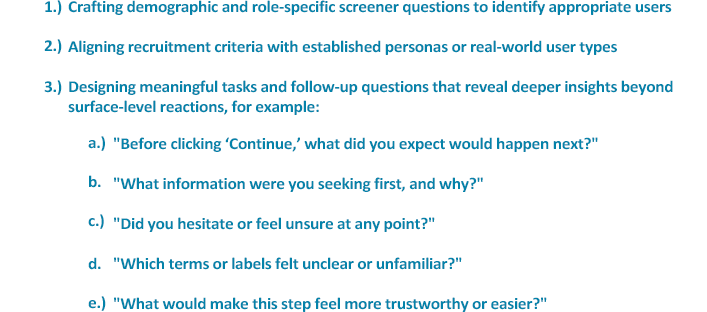
This approach helps teams understand user actions and the reasons behind any confusion or mistakes. It informs better requirements and design outcomes.
Harnessing AI for Smarter Testing
When usability testing is used in Agile delivery, teams need to be efficient.
At OPTiMO, we use usability testing platforms that improve both the speed and impact of testing efforts. These tools help teams:
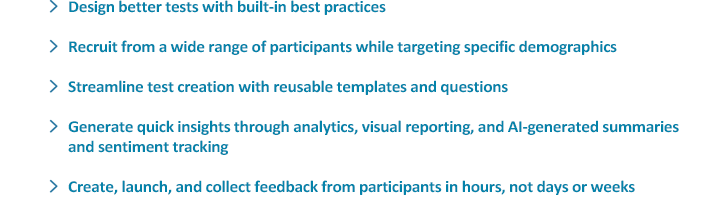
AI-supported analysis helps teams collect and summarize findings quickly, spot patterns, and communicate results effectively to stakeholders. Faster testing overall means quicker decisions and more user-centered outcomes.
Business Analysis, Quality Assurance and UX: A Collaborative Powerhouse
OPTiMO strengthens human-centered delivery through a collaborative approach to usability testing, enabling our experts in business analysis, quality assurance, UX research, and design to turn insights into coordinated action. Together, they create deliverables such as:
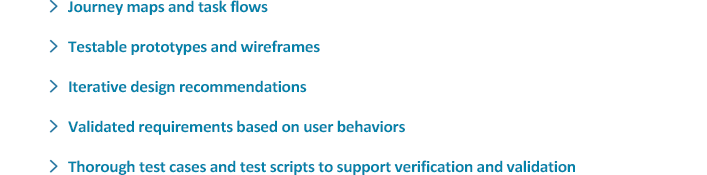
This cooperation ensures that usability findings don’t stay isolated; they drive real design changes and improvements in delivery.
Iterating with Purpose Across the Agile Lifecycle
Usability testing is most effective when it is seen as an ongoing practice, not just a one-time event.
OPTiMO integrates testing throughout the Agile lifecycle, including:

Testing early, regularly, and purposefully helps teams lower risk, boost adoption, and consistently enhance customer experience over time.
In Summary
OPTiMO’s approach to usability testing differentiates our delivery model from simple checkbox implementations.
By introducing usability testing early in project lifecycles, our teams move faster from concept to solution, ensuring outcomes meet real user needs.
This approach reinforces:

Ultimately, business analysis is not just about documenting what a system should do. It is about making sure what we build truly works for users.
At OPTiMO, we are committed to delivering transformative, data-driven, and user-focused solutions that help agencies advance their missions with clarity, trust, and impact.